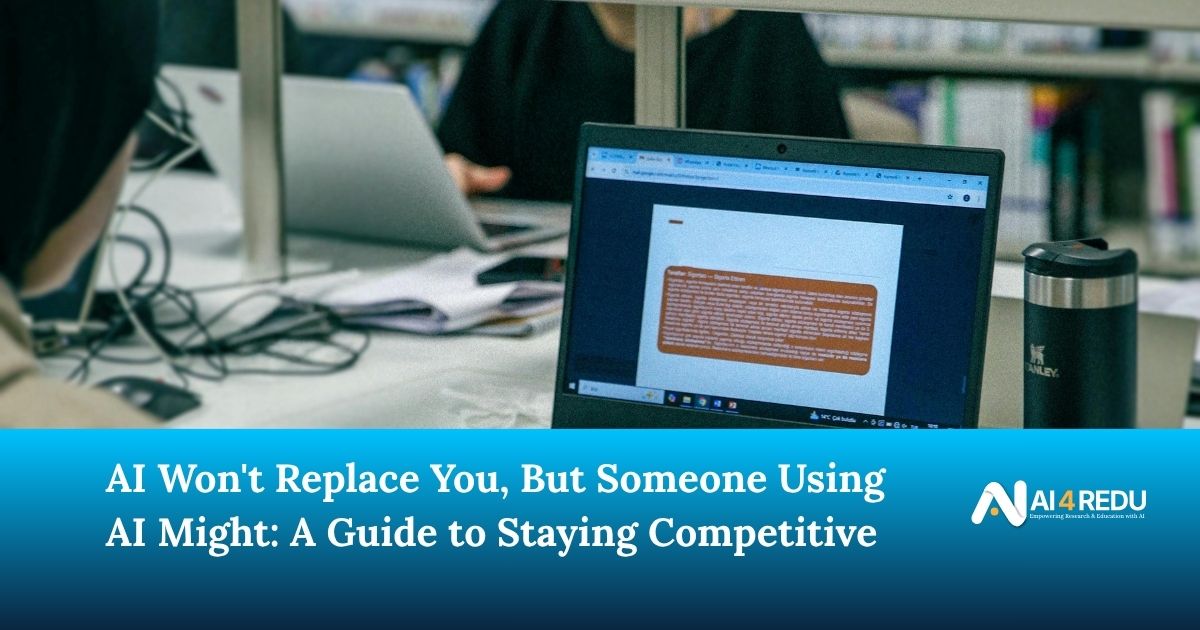
AI Won’t Replace You, But Someone Using AI Might: A Guide to Staying Competitive
If you are a university student preparing for your first serious job, you have probably heard some version of the same warning: AI is coming for your job.
That prediction is both too simple and, in some ways, less useful than another possibility.
The bigger career risk may not be that an AI system replaces you. It may be that another graduate, with similar qualifications, similar experience and similar ambitions, learns how to use AI to work faster, research more effectively, communicate more clearly and solve problems at a higher level.
In other words, the competition may increasingly be human versus human, with AI as the multiplier.
That does not mean every student needs to become a programmer or AI specialist. It means learning how to combine your existing subject knowledge with artificial intelligence, while retaining the judgement, creativity, communication and critical thinking that technology cannot simply outsource.
Recent global research supports this more nuanced picture. The International Labor Organization (ILO) estimates that roughly one in four workers globally are in occupations with some exposure to generative AI, but says transformation is more likely than outright replacement for most jobs. Meanwhile, the World Economic Forum’s Future of Jobs Report 2025 projects major labor-market disruption, with 170 million jobs created and 92 million displaced by broader economic and technological trends by 2030.
For students, the lesson is not to panic. It is to prepare.
The “Augmentation, Not Replacement” Argument and Its Limits
The idea of AI augmentation is straightforward: rather than completely eliminating a job, AI changes how a person performs it.
Think about a marketing student working on a campaign. AI might generate initial ideas, analyze customer feedback, suggest headlines or create a first draft. But the student still has to understand the audience, decide which ideas fit the brand, check whether claims are accurate and determine what the campaign is ultimately trying to achieve.
The same principle applies across professions.
A software developer can use AI to explain unfamiliar code, generate tests or produce a first implementation. A journalist can use AI to organize interview notes or identify themes in a large collection of documents. A researcher can use it to brainstorm search terms or structure information.
The human contribution does not disappear. Instead, the location of human value changes.
The ILO’s research is particularly relevant here. Its 2025 global index found that 25% of global employment is potentially exposed to generative AI, while only 3.3% falls into its highest exposure category. The organization emphasizes that transformation of jobs is more likely than full automation.
That sounds reassuring—but there is an important limitation.
“AI will augment workers” does not mean that everyone’s job will remain unchanged.
If AI allows one employee to complete in two hours what previously took a full working day, employers may eventually expect more output from that employee. Entry-level tasks may become automated. Some traditional routes into professions could shrink. Organizations may hire fewer people for certain routine activities while demanding more advanced skills from those they do employ.
This is why the augmentation argument should not become an excuse for complacency.
The real question for students is: What happens when everyone has access to the same AI tools?
At that point, simply knowing how to open an AI chatbot will not be a competitive advantage. The advantage will come from knowing what to ask, what information to provide, how to evaluate the response, how to combine AI with other tools and when not to use AI at all.
That is the difference between AI literacy and genuine AI-augmented capability.
What AI-Augmented Work Looks Like in Practice
AI-augmented work is not about asking a chatbot to “do everything”.
A stronger workflow divides work between the human and the AI according to their relative strengths.
AI can be particularly useful for tasks involving speed, pattern recognition, summarization, drafting, comparison and idea generation. Humans remain essential for setting objectives, understanding context, exercising judgement, handling relationships, making consequential decisions and taking responsibility for outcomes.
Consider a typical university-to-work transition. A student might use AI to:
- brainstorm possible approaches to a problem;
- turn unstructured notes into an outline;
- explain an unfamiliar concept;
- generate alternative ways to communicate an idea;
- analyze a spreadsheet or dataset;
- create a first draft of routine material;
- identify weaknesses in their reasoning;
- simulate questions for an interview;
- practice presentations or professional communication.
The important word is first.
A first draft is not a finished product. A suggested answer is not automatically a correct answer. AI output requires verification, editing and context.
Microsoft’s 2025 Work Trend Index illustrates how quickly this model is developing. Its research surveyed 31,000 professionals across 31 countries and found that organizations are moving towards hybrid teams involving humans and AI agents. The report found that 78% of leaders were considering hiring for new AI-specific roles, while 47% identified upskilling existing employees as a top priority.
That suggests employers may increasingly value people who can work effectively with AI rather than simply people who have encountered AI in a classroom.
Case Studies: Marketing, Software Development, Journalism
Marketing: Imagine a graduate marketer preparing a product launch. AI could help analyze customer comments, generate multiple campaign concepts, create variations of copy and identify common themes in research. The marketer’s job is then to evaluate those options, understand the customer, protect the brand and choose a strategy.
The competitive advantage comes from combining marketing expertise with AI-assisted speed.
Software development: A computer science graduate can use AI to explain unfamiliar functions, generate boilerplate code, suggest debugging approaches and create test cases. But professional development still requires understanding architecture, security, performance, maintainability and the requirements of the user.
A developer who blindly accepts AI-generated code is not necessarily competitive. A developer who can review, improve and direct AI-generated code may be competitive.
Journalism: A journalism student might use AI to organize transcripts, compare documents, generate questions for follow-up interviews or identify inconsistencies worth investigating. But journalism’s core responsibilities—verification, source protection, context, editorial judgement and accountability—remain human responsibilities.
The lesson across all these three fields is the same: AI handles parts of the workflow; the professional owns the outcome.
The Skills Gap Between AI Users and AI Non-Users
The future workplace may contain a new kind of skills gap.
It will not necessarily be “people who know AI” versus “people who do not”. Instead, there may be a spectrum ranging from people who occasionally use AI for simple tasks to people who have redesigned their workflows around it.
Consider two graduates with similar qualifications.
Graduate A spends several hours researching a topic, manually produces a first draft and then edits it.
Graduate B uses AI to brainstorm the research structure, identify questions, organize information and challenge the initial argument. Graduate B then independently verifies important claims, adds subject expertise and produces the final work.
The second graduate is not necessarily better because AI wrote more of the content. They are potentially more productive because they have designed a better process.
This distinction matters because the World Economic Forum expects technological change to be one of the major forces reshaping employment through 2030. Its Future of Jobs Report 2025 identifies AI and information-processing technologies among the key forces affecting businesses and highlights growing demand for technology-related skills alongside human capabilities.
There is also a global inequality dimension. An ILO–World Bank analysis published in 2026 found that developing economies may experience disruption before seeing the productivity benefits of generative AI because of differences in digital infrastructure and work patterns. At the same time, developing economies can still have substantial potential for task augmentation.
For students, this makes access and capability especially important. Having an AI tool is only the beginning. The valuable skill is knowing how to use it responsibly and effectively within your field.
The most durable combination is therefore:
Domain knowledge + AI literacy + critical thinking + communication + human judgement.
Do not abandon your degree because AI exists. Instead, become unusually good at applying AI to your discipline.
“Consider two graduates with similar qualifications.”
The difference can become even more significant when students enter the workplace. Employers are not only looking for people who can complete assigned tasks; they increasingly need employees who can improve how those tasks are completed. An AI-literate graduate can spot opportunities to automate repetitive work, test new approaches and use technology to produce better results. This does not make traditional skills irrelevant. Instead, it raises their value because employees need enough subject knowledge to recognize poor AI output, enough judgment to make decisions and enough communication ability to explain their conclusions. Building this combination while at university can therefore give students an advantage before, they even begin their careers.
A Simple Framework for Building Your Own AI Workflow
You do not need to redesign your entire life around artificial intelligence. Start with one repeatable workflow.
1. Identify repetitive tasks
Look at your studies, internships, part-time work or student projects. Which activities consume time without requiring much original judgement?
These might include summarizing background material, generating practice questions, organizing notes, drafting routine communications or cleaning up data.
Start there.
2. Give AI the preparation work, not automatic authority
Use AI to accelerate the beginning of a task. Ask it to produce options, structures, questions or preliminary analysis.
Then take control.
Check the output. Correct mistakes. Add information the AI does not know. Challenge its assumptions.
3. Build verification into the process
AI systems can produce confident but inaccurate information. For academic and professional work, particularly where facts matter, verification is part of the workflow—not an optional final step.
Check important statistics, quotations, references, calculations and claims against reliable sources.
4. Develop better prompts through experimentation
Prompting is less about discovering a magical phrase and more about giving useful context.
Explain the objective, audience, constraints, available information and desired format. Ask the AI to identify assumptions or weaknesses rather than merely asking for an answer.
For example, instead of: “Write my presentation.”
Try: “Act as a critical reviewer. Here is my presentation outline. Identify three weaknesses in the argument, explain what evidence I would need to strengthen each one, and suggest questions an audience might ask.”
The second approach keeps you in control.
5. Measure the improvement
Ask yourself whether AI actually improved your work.
Did you save time? Produce better ideas? Discover an error? Understand a difficult concept? Improve your communication?
If the answer is no, change the workflow—or do the task without AI.
6. Keep developing human skills
The more capable AI becomes, the more valuable certain human abilities may become: asking good questions, understanding people, negotiating, presenting ideas, making decisions under uncertainty and taking responsibility.
AI should make those abilities more powerful, not replace your effort to develop them.
Your Competitive Advantage Is Not “Knowing AI”
The phrase “AI won’t replace you” can be comforting, but it is incomplete.
Some jobs and tasks will disappear or shrink. Others will change significantly. New roles will emerge. Entry-level work may be redesigned. Employers will continue experimenting with automation and AI agents.
The more useful message for students is this: Do not compete with AI. Learn to compete with people who know how to use AI well.
That does not mean becoming dependent on technology. It means becoming the person who can combine technology with expertise.
Microsoft’s 2025 research found that leaders were substantially more familiar with AI agents than employees, while organizations were already considering new AI-focused roles and greater investment in workforce upskilling. The direction is clear: AI capability is moving from an interesting extra to a workplace skill.
Your degree gives you a foundation. Your internships and projects give you experience. Your communication and critical-thinking skills make you effective. AI can amplify all of them.
The students best positioned for the changing job market will not necessarily be those who use the most AI.
They will be the ones who understand where AI creates value, where human expertise matters more, and how to bring the two together.
Start now. Pick one task you do every week. Experiment with an AI-assisted workflow. Check the results. Improve the process. Then apply the same thinking to another task.
That is how AI literacy becomes career capability and how you turn a potential competitive threat into a competitive advantage.
Related posts: