The Industries Being Rebuilt by AI Right Now, and What That Means for You
Choosing a degree or career path has never been completely straightforward. But for today’s university students, there is an additional question: How will artificial intelligence change the industry I am preparing to enter?
The question matters because AI is moving beyond technology companies. Healthcare organizations are using it to support diagnosis and reduce administrative work. Financial institutions are applying it to fraud detection, customer service and risk analysis. Law firms are experimenting with AI for contract review and legal research. Manufacturers are combining AI with robotics, sensors and predictive systems.
This does not mean that entire professions will suddenly disappear. In fact, recent research points more strongly towards job transformation than wholesale replacement. The International Labor Organization (ILO) estimates that one in four workers globally is in an occupation with some exposure to generative AI, while its research suggests that transformation of tasks is more likely than complete automation for most occupations.
At the same time, the labor market is changing quickly. The World Economic Forum’s Future of Jobs Report 2025 estimates that 170 million jobs could be created globally by 2030 while 92 million could be displaced, producing a net increase of 78 million jobs. It also estimates that nearly 40% of the skills required at work could change.
For students, the lesson is not to find a career that is “AI-proof”. Instead, look for careers where you can work effectively with AI, understand its limitations and contribute something that technology cannot easily replicate.
Healthcare: Diagnostics, Admin, and the Rise of AI-Assisted Clinicians
Healthcare is one of the clearest examples of an industry where AI is likely to change jobs without eliminating the need for professionals.
AI is already being used in areas including medical imaging, diagnosis, disease surveillance, drug development and health-system management. The World Health Organization (WHO) describes AI as already playing a role across diagnosis and clinical care as well as wider health-system functions.
AI is becoming a clinical assistant
One of the most visible applications is AI-assisted diagnostics.
Machine-learning systems can analyze medical images and other clinical information to identify patterns that may be difficult or time-consuming for humans to detect. In the United States, the Food and Drug Administration maintains a growing list of authorized AI-enabled medical devices, including applications in radiology and cardiovascular care.
But an AI system identifying an abnormality does not automatically mean a doctor is unnecessary.
Healthcare decisions involve context, uncertainty, communication and responsibility. A clinician must consider symptoms, medical history, patient preferences and the consequences of acting on an uncertain result.
That creates an important career trend: AI-assisted clinicians rather than AI replacing clinicians.
A medical student who learns how to interpret AI-generated recommendations, question unreliable outputs and communicate complex information to patients may be better positioned than one who treats AI as irrelevant to clinical practice.
Administrative work may change even faster
Some of the biggest changes may happen away from the operating theatre.
Healthcare professionals spend substantial time documenting appointments, updating records, preparing reports, dealing with billing and completing other administrative tasks. WHO guidance notes that large multimodal models are beginning to assist with clerical, administrative and financial aspects of healthcare.
That could make AI particularly valuable for reducing paperwork.
For students considering healthcare careers, this means that technical literacy will increasingly complement clinical expertise. Doctors, nurses, pharmacists, public-health professionals and health administrators may all need to understand how digital systems influence their work.
The opportunity is therefore not simply to become an “AI healthcare specialist“. It is to become a healthcare professional who knows when AI should be used, when it should be questioned and when a human decision must take priority.
Finance: Algorithmic Everything and the New Analyst Role
Finance has always been heavily influenced by technology, so AI is entering an industry that is already accustomed to automation, data analysis and algorithms.
Banks, insurers, asset managers and fintech companies are increasingly using AI for tasks such as fraud detection, customer interaction, coding, process automation and risk analysis. The Bank of England reported in 2025 that AI was already helping financial institutions automate and optimize internal processes, while more advanced applications could increasingly influence decisions such as credit and insurance underwriting.
The analyst’s job is being redesigned
For decades, junior analysts have performed work involving spreadsheets, financial research, document review, data gathering and presentation preparation.
AI can increasingly assist with many of these tasks.
That does not make financial analysts obsolete. It changes what employers may expect from them.
Instead of spending hours collecting information, an analyst might use AI to produce an initial analysis and then spend more time checking assumptions, identifying risks, interpreting results and explaining recommendations.
The value shifts from producing information to judging information.
That distinction matters for university students. If AI can generate a first-draft market analysis in seconds, simply knowing how to produce a conventional analysis may become less differentiating.
Understanding economics, statistics, accounting and finance remains important. But students should also develop data literacy, critical thinking and the ability to work with AI tools.
Finance also needs people who understand AI risk
AI adoption brings new risks alongside productivity gains.
The Bank of England has highlighted concerns including operational risks, cybersecurity and the possibility that AI-driven financial decisions could increase correlations between firms and amplify market shocks.
This creates opportunities for people who understand both finance and technology.
Potential career directions include financial data analysis, AI governance, model risk, cybersecurity, fintech, quantitative finance and regulatory technology.
The future finance professional may therefore be less like the traditional spreadsheet-heavy analyst and more like a decision-maker who can interrogate automated systems.
Law: Contract Review, Legal Research, and the Junior Associate Debate
Law is another profession where AI is changing tasks traditionally associated with junior professionals.
Generative AI can help review documents, summarize cases, identify clauses, conduct research and generate initial drafts. These applications are particularly significant because much legal work involves processing large quantities of text.
What happens to entry-level legal work?
This is one of the most important questions for law students.
Historically, junior lawyers have often learned through tasks such as reviewing contracts, conducting legal research and preparing initial documents. If AI can perform some of this work more quickly, firms may need fewer hours of junior-level document processing.
But that does not necessarily mean fewer lawyers overall.
The more likely change is that junior lawyers will need to develop substantive judgement earlier. Instead of spending most of their time finding information, they may be expected to evaluate AI-generated material, identify errors, communicate with clients and handle more complex legal reasoning.
Research from Thomson Reuters’ Future of Professionals Report 2025 found that legal professionals expected AI to free up nearly 240 working hours per year under the report’s adoption assumptions, up from 200 hours in its previous edition.
Legal skills will become more human and more technical
Law students therefore have two reasons to learn about AI.
First, they need to understand how AI can improve legal workflows.
Second, they need to understand its weaknesses.
AI can produce confident but incorrect answers. Legal professionals must verify sources, protect confidential information and consider ethical and regulatory requirements.
The strongest future lawyers may combine legal knowledge, technological fluency and human judgement.
That also means students should not assume that learning to use one AI chatbot is enough. The valuable skill is understanding how AI fits into professional processes: research, verification, drafting, client service, compliance and decision-making.
Manufacturing and Logistics: Predictive Systems and Robotics
AI’s impact is not limited to office-based professions.
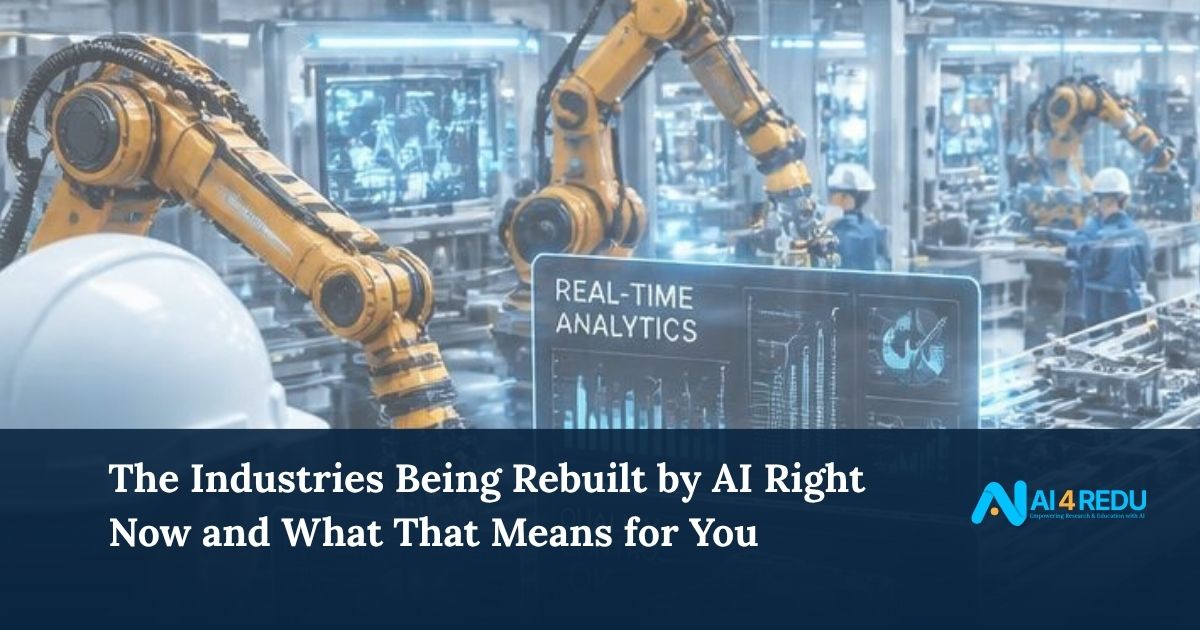
Manufacturing and logistics are becoming increasingly automated through the combination of AI, robotics, sensors, computer vision and data analytics.
Predictive systems are changing factory work
Traditional maintenance often involves fixing machinery after a problem occurs or performing maintenance according to a fixed schedule.
Predictive maintenance takes a different approach.
Sensors can collect information about equipment, while AI systems analyze patterns to identify signs of potential failure. Maintenance teams can then intervene before a breakdown causes expensive downtime.
This creates a different type of technical job. Workers increasingly need to understand machines, data and software together.
The International Federation of Robotics reported that 431,240 industrial robots were installed across the five largest robot markets in 2024, with China, Japan, the United States, South Korea and Germany accounting for 80% of global installations.
Robotics does not mean “no humans”
Factories still require engineers, technicians, managers, quality specialists and workers who can respond when automated systems behave unexpectedly.
In logistics, AI can optimize routes, forecast demand and manage warehouses, but human oversight remains important when conditions change.
For students, this makes engineering, mechatronics, computer science, supply-chain management and industrial data analysis potentially strong combinations.
The most valuable worker may increasingly be the person who understands how an automated system works and what to do when it does not work as expected.
Choosing a Sector: Questions to Ask Before You Specialize
With AI changing so many industries, how should a student choose a career?
The first mistake is to ask: “Which jobs will AI never replace?”
No one can reliably answer that question. Technology changes too quickly, and exposure to AI does not automatically translate into job losses.
A better question is: “Where can I develop skills that become more valuable when combined with AI?”
1. How much of the job involves repetitive tasks?
Jobs built around predictable information processing are likely to experience significant AI-driven change.
That does not automatically make them bad career choices. It means you should understand how the role is evolving.
2. Does the sector require human judgement?
Healthcare, law and finance all involve decisions with significant consequences. Human judgement, accountability, communication and ethical reasoning remain important even when AI contributes to the process.
3. Can you combine domain expertise with technology?
A computer scientist who understands healthcare can be valuable. A finance graduate who understands AI governance can be valuable. A lawyer who understands technology regulation can be valuable.
Hybrid skills are becoming increasingly important.
4. Are you prepared to keep learning?
The ILO’s 2026 research with the World Bank highlights an important global issue: developing economies may experience disruption from GenAI before fully realizing its productivity benefits because of differences in digital infrastructure and the tasks performed in different economies.
That means students should think beyond their first job. Digital skills, communication, analytical thinking and adaptability can help people move as particular tasks evolve.
The World Economic Forum similarly identifies AI, big data and cybersecurity among the fastest-growing skill areas while emphasizing that human capabilities such as creative thinking, resilience, flexibility and leadership remain important.
5. Can you demonstrate your skills?
A degree is still valuable, but employers increasingly want evidence that graduates can apply what they have learned.
Build projects. Complete internships. Analyze real datasets. Experiment with appropriate AI tools. Learn how to verify AI outputs. Develop a portfolio that demonstrates both technical capability and judgement.
The goal is not to become the person who knows the most about AI.
It is to become the person who can use AI intelligently within a real profession.
The Bigger Career Lesson
AI is not rebuilding every industry in exactly the same way.
In healthcare, it may reduce administrative burdens and support diagnosis. In finance, it may automate analysis and reshape decision-making. In law, it may absorb some document-heavy junior work. In manufacturing and logistics, it is combining with robotics to create increasingly intelligent physical systems.
Across all four sectors, however, one pattern stands out: tasks are changing faster than job titles.
The ILO’s latest research reinforces this point. One in four workers globally is potentially exposed to GenAI, but the most likely outcome for most occupations is transformation rather than complete replacement.
For university students, that is both a warning and an opportunity.
Do not choose a degree simply because you think AI cannot touch it. And do not abandon an industry because AI is entering it.
Instead, look for the intersection of subject expertise, technological literacy and human judgement.
The future of work will not belong exclusively to people who build AI. It will increasingly belong to people who know how to use it responsibly, challenge it intelligently and apply it to problems that matter.
That is a much more useful career strategy than trying to predict which job titles will survive unchanged.
Related post