
Learn how the FATE framework AI helps universities build fair, accountable, transparent, and ethical AI systems while promoting trust and responsible governance.

Discover the SHARE Framework for scholarly co-writing with generative AI — five principles for responsible, ethical AI use in academic research and writing.

Discover how the Human-in-the-Loop (HITL) Framework keeps human oversight at the center of AI-assisted research, protecting academic integrity, accuracy, and accountability.

Learn how researchers and universities can implement responsible AI in research — covering bias mitigation, transparency, accountability, and governance best practices for trustworthy, reproducible science.

Explore the AI ethics frameworks shaping academic publishing — from ACM and COPE to Elsevier, Wiley, and Springer Nature — and learn the shared rules on disclosure, authorship, and accountability.

Explore the world’s top AI governance frameworks — UNESCO, OECD, NIST, ISO/IEC 42001, Singapore’s Model Framework, and more — and how they enable responsible, trustworthy AI.

Discover how universities in Australia and Oceania — from Sydney and Monash to Auckland and USP — are building AI governance frameworks that balance innovation with academic integrity.
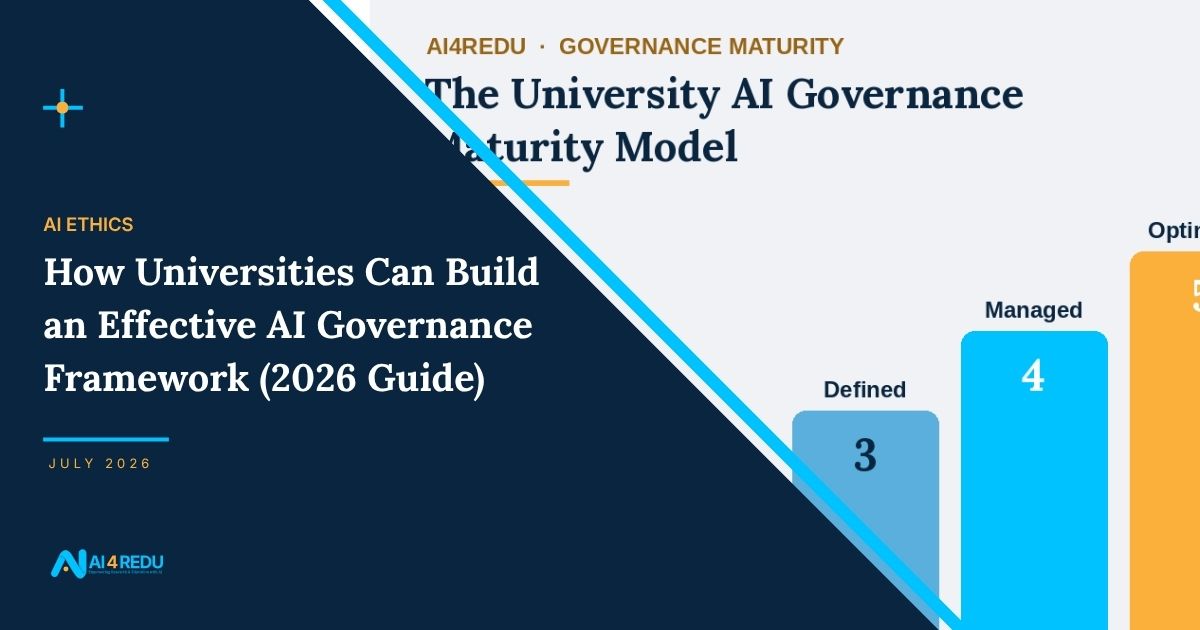
A practical guide to AI governance in higher education — core principles, the 4 governance pillars, a maturity model, and real university case studies.

Explore 6 future trends shaping AI ethics in higher education — from AI governance and literacy to assessment redesign and research integrity — with practical examples for universities.
Introduction Generative artificial intelligence has moved from novelty to necessity on college and university campuses. Yet recognizing AI’s transformative potential is one thing; translating ethical AI principles into day-to-day institutional practice is quite another. For most higher education institutions, implementing …