
How Universities Can Build an Effective AI Governance Framework (2026 Guide)
AI governance isn’t about slowing innovation down — it’s what makes responsible AI adoption possible at scale. Here’s how leading universities are building frameworks that work.
Introduction: Why Every University Needs an AI Governance Strategy
Artificial intelligence is no longer an emerging trend in higher education — it’s already embedded in how students learn, researchers work, and institutions operate. From generative AI tools in the classroom to machine learning models accelerating scientific discovery, AI is reshaping what universities can achieve.
But that transformation comes with real risk. Without coordinated oversight, institutions face inconsistent AI practices across departments, academic integrity gray areas, data privacy exposure, algorithmic bias, and growing regulatory pressure.
This is where an AI governance framework for universities becomes essential. Rather than restricting innovation, a well-designed framework gives institutions the policies, accountability structures, and ethical guardrails needed to adopt AI confidently — protecting academic values and institutional reputation along the way. In this guide, we break down the core components of university AI governance, a practical five-phase implementation roadmap, who should own what, and how top universities like Oxford, Michigan, Sydney, and NUS are approaching it in practice.
Key Terms to Know
| Term | Definition |
| AI Governance | Institutional policies, structures, and oversight mechanisms guiding responsible AI use. |
| AI Governance Framework | A structured approach defining principles, roles, policies, and accountability for AI adoption. |
| Responsible AI | AI that is ethical, transparent, fair, accountable, secure, and human-centred. |
| AI Literacy | The knowledge and skills needed to evaluate, use, and govern AI responsibly. |
| Risk-Based Governance | Applying governance controls in proportion to the level of AI-related risk. |
| Human Oversight | Meaningful human involvement in AI-supported decisions with academic or ethical stakes. |
| AI Oversight Committee | A multidisciplinary body responsible for institutional AI governance and compliance. |
What Is AI Governance in Higher Education?
AI governance in higher education covers the institutional policies, processes, oversight structures, and ethical principles that guide how AI is developed, procured, deployed, and used across teaching, research, administration, and student services.
It goes further than traditional IT governance. A robust framework addresses:
- Ethical AI use and human oversight
- Transparency and explainability
- Fairness and bias mitigation
- Privacy and data protection
- Academic integrity and research ethics
- Regulatory compliance
- Continuous monitoring and improvement
Because universities operate simultaneously as educators, researchers, and innovators, governance has to strike a careful balance — supporting technological progress without compromising academic freedom, accountability, or public trust.
Why AI Governance Matters Right Now
The rapid rise of generative AI has already changed how faculty design assessments, how researchers work, and how administrators think about automation. Without a coordinated governance approach, institutions risk:
- Inconsistent AI practices across departments
- Uneven academic integrity standards
- Data privacy and cybersecurity exposure
- Algorithmic bias in decision-making
- Intellectual property disputes
- Limited transparency in AI-assisted processes
- Regulatory non-compliance
A university-wide framework sets consistent expectations while still leaving room for disciplinary differences — so a medical school and a humanities department can both operate responsibly, just not identically.
Six (6) Core Principles of Responsible AI Governance
Across international frameworks — from UNESCO to the OECD to NIST — six principles come up again and again:
- Human-Centred Decision-Making — AI should support, not replace, human judgment in significant academic and administrative decisions.
- Transparency — Stakeholders should understand when and how AI is being used, including its purpose, limitations, and underlying data.
- Fairness and Equity — AI systems should be regularly assessed for bias and discriminatory impact across diverse communities.
- Accountability — Governance structures should clearly assign responsibility for AI decisions, oversight, and policy compliance.
- Privacy and Data Protection — AI should operate within institutional data governance policies and applicable privacy law.
- Continuous Improvement — Frameworks should evolve through regular review, stakeholder engagement, and emerging regulatory guidance.
Effective governance doesn’t restrict innovation — it builds the institutional confidence and trust needed to adopt AI responsibly at scale.
The 4 Pillars of an AI Governance Framework for Universities
Building effective governance takes more than a single generative AI policy. It requires an institutional ecosystem across four strategic pillars.
Pillar 1: Strategic Governance
Everything starts with a clear institutional vision that answers three questions:
- How does AI advance the university’s mission?
- Which academic values must AI protect?
- What outcomes should AI deliver for students, researchers, faculty, and society?
That vision should be backed by institution-wide governance principles that apply consistently across teaching, research, administration, procurement, and student services.
Best Practice: Publish your institutional AI principles as a public governance statement. Transparency here builds accountability and stakeholder trust.
Leadership and governance structure typically includes:
- Executive leadership sponsorship
- An AI governance committee
- Faculty representatives
- Research leadership
- IT services
- Data governance specialists
- Legal and privacy officers
- Library and digital scholarship representatives
- Student representation where appropriate
Pillar 2: Operational Governance
This is where policy becomes practice — through oversight, risk management, and data governance.
AI oversight committees typically:
- Review AI initiatives across the institution
- Assess institutional risk
- Develop AI policies
- Monitor compliance
- Advise executive leadership
- Track emerging legislation
- Recommend governance improvements
Their goal is to enable responsible innovation — not create unnecessary bureaucracy.
Risk-based governance means applying oversight proportionate to risk level:
| AI Application | Risk Level |
| Grammar assistance | Low |
| Course content generation | Moderate |
| Student advising chatbots | Moderate–High |
| Admissions decision support | High |
| Research involving human participants | High |
| Automated grading | High |
| Clinical decision-support research | Very High |
Risk assessments should weigh bias, privacy, cybersecurity, explainability, human oversight, reliability, intellectual property, academic integrity, and regulatory compliance.
Data governance underpins all of this. Institutional policy should define approved data sources, data quality standards, consent requirements, secure storage, retention periods, cross-border transfer rules, third-party vendor access, and appropriate use of public AI platforms.
Pillar 3: Academic Governance
Academic governance translates principles into practical guidance for teaching, learning, and research.
Ethics review should apply to higher-risk applications such as human participant research, predictive student analytics, AI-assisted recruitment, learning analytics, and academic progression systems. Specialist AI ethics panels can complement existing research ethics committees.
Procurement governance should evaluate vendors on data ownership, privacy protections, transparency, security, accessibility, bias testing, intellectual property, data residency, and human oversight.
Practical Tip: Governance starts before procurement — build AI-specific evaluation criteria directly into your purchasing process.
Teaching, learning, and research guidance should be context-specific rather than a blanket policy:
| Teaching | Student Learning | Research |
| AI-assisted lesson preparation | Responsible AI use | Literature reviews |
| Accessibility support | Citation expectations | Data analysis |
| Classroom guidance | Academic integrity | Code generation |
| Student disclosure | Independent assessment | Manuscript preparation |
Appropriate AI use looks very different in medicine versus law versus the humanities — discipline-specific guidance matters.
Pillar 4: Institutional Capability
Governance is sustained through learning, not policy documents alone.
AI literacy programmes should be tailored to faculty, students, researchers, executive leaders, IT professionals, and procurement teams — combining technical understanding with ethical reasoning and critical evaluation skills.
Continuous improvement is non-negotiable. The Alan Turing Institute notes that effective governance combines leadership, ethical decision-making, stakeholder engagement, transparency, and continuous evaluation across the full AI lifecycle. That means universities should:
- Review governance regularly
- Monitor AI impacts
- Engage diverse stakeholders
- Update policy as technology and regulation evolve
Executive Insight: Treat AI governance as a strategic institutional capability — not just a compliance function. Institutions that continuously learn and adapt will out-innovate those that don’t, while maintaining academic integrity and public trust.
The University AI Governance Maturity Model
Governance maturity develops in stages:
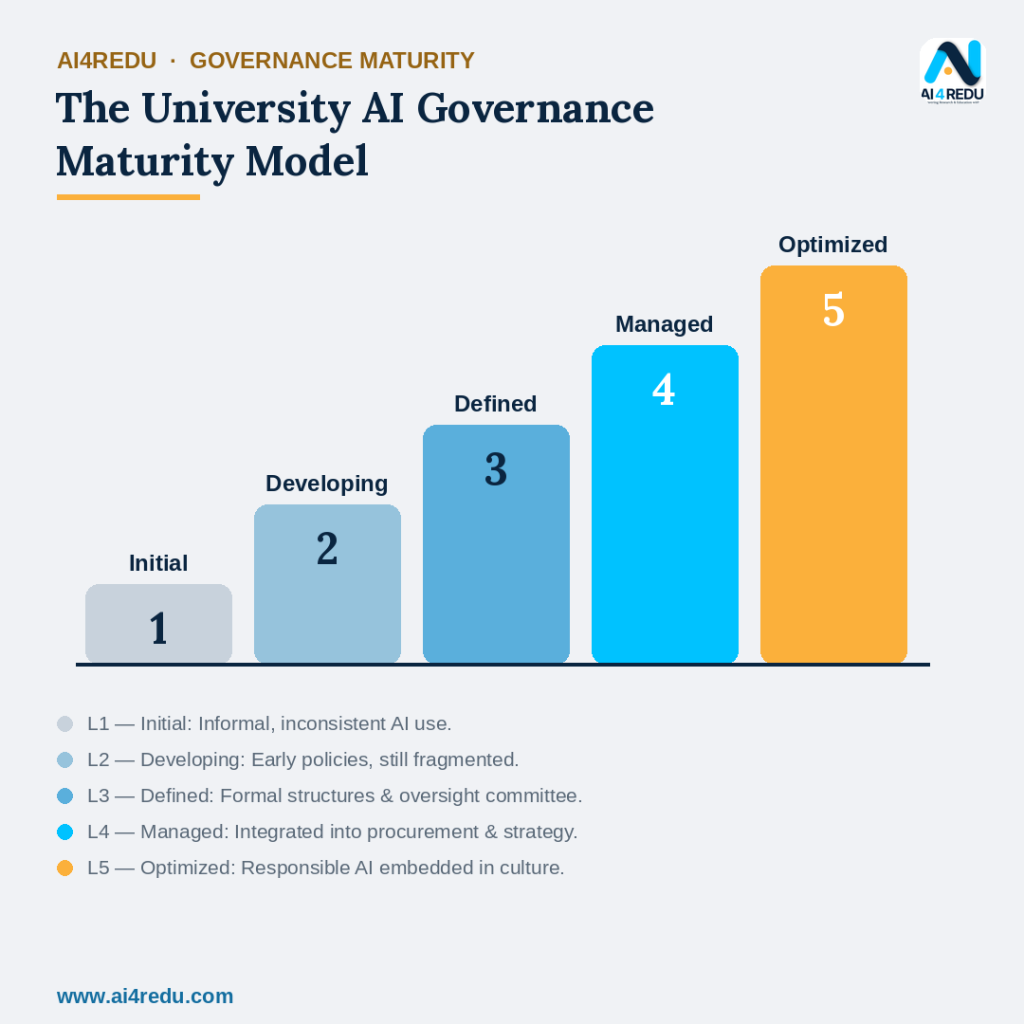
The different maturity levels are further explained below:
| Maturity Level | Institutional Characteristics |
| Level 1 – Initial | AI use is informal, with limited guidance and inconsistent practices. |
| Level 2 – Developing | Initial policies exist, often focused on generative AI, but governance is fragmented. |
| Level 3 – Defined | Formal structures, AI policies, risk assessments, and an oversight committee are in place. |
| Level 4 – Managed | AI governance is integrated into procurement, research ethics, data governance, and strategic planning. |
| Level 5 – Optimized | Governance is continuously improved through audits, AI literacy, and alignment with global best practice — responsible AI becomes embedded in institutional culture. |
Key Takeaway: Treat AI governance as a continuous capability-building journey, not a one-time compliance exercise. Progressing through these levels builds trust, reduces risk, and enables innovation.
Five (5) Steps to Build Your Institutional AI Governance Strategy
Establishing governance structures is only the beginning. Universities need a structured implementation strategy to turn principles into sustainable practice.
| Phase | Key Activity | Expected Outcome |
| 1. Discovery | Assess current AI use, identify risks, engage stakeholders | Shared understanding of institutional AI adoption |
| 2. Strategy | Define the AI vision, governance principles, executive sponsorship | Clear strategic direction and leadership commitment |
| 3. Design | Establish governance structures, policies, oversight committees | Formal framework with defined accountability |
| 4. Implementation | Launch AI literacy programmes, risk assessments, pilot processes | Responsible AI practices embedded institution-wide |
| 5. Continuous Improvement | Monitor outcomes, review policy, conduct audits | A resilient framework that evolves with change |
Executive Insight: Universities that treat AI governance as iterative — rather than a fixed policy to “finish” — are far better positioned to respond to new technologies while protecting academic integrity, public trust, and regulatory compliance.
Who Owns AI Governance? Roles and Responsibilities
Effective governance depends on clearly shared accountability — not a single department carrying the whole load.
- Governing Board & Executive Leadership — Set AI vision, approve governance principles, allocate resources, oversee institutional risk.
- Provosts & Academic Leadership — Develop teaching guidance, support assessment redesign, coordinate implementation across faculties.
- CIO & IT Services — Evaluate AI technologies, secure infrastructure, manage cybersecurity and approved AI systems.
- Research Office & Research Integrity Teams — Develop AI research guidance, support responsible data management.
- Research Ethics Committees / IRBs — Review higher-risk AI research involving human participants or predictive algorithms.
- Legal, Privacy & Compliance Offices — Interpret regulation, review vendor contracts, manage institutional liability.
- Faculty Members — Model responsible AI use, redesign assessments, safeguard academic integrity.
- Libraries & Teaching Centres — Deliver AI and information literacy, citation guidance, professional development.
- Students — Use AI responsibly, disclose AI assistance where required, contribute to governance consultations.
- AI Governance Committee — Coordinate institutional governance, review high-risk initiatives, advise leadership.
Key Takeaways:
- AI governance is a shared responsibility across leadership, academic, research, technical, legal, and student communities.
- Clear ownership reduces duplication and strengthens trust.
- Governance committees should coordinate existing structures — not replace them.
Real-World Examples: How 4 Universities Approach AI Governance
There’s no single template for AI governance in higher education — but some common threads run through the institutions doing it well: executive leadership, multidisciplinary oversight, responsible AI principles, faculty engagement, AI literacy, and continuous review.
University of Oxford: Discipline-Specific Flexibility
Oxford combines institution-wide principles with discipline-specific implementation, letting departments determine appropriate AI use within their own academic context while holding a consistent line on academic integrity.
Governance highlights: discipline-specific implementation, faculty-owned assessment design, continuous review, strong academic integrity focus.
Lesson: Balance institutional consistency with disciplinary flexibility.
University of Michigan: Governance as Institutional Capability
Michigan treats governance as more than compliance — pairing policy with faculty development, AI literacy, and practical guidance across teaching, research, and administration.
Governance highlights: institution-wide guidance, faculty development, communities of practice, responsible experimentation, human oversight.
Lesson: Governance works best when paired with AI literacy and ongoing professional development.
University of Sydney: Governance Embedded in Educational Strategy
Sydney connects responsible AI use directly to teaching, assessment, academic integrity, and student support — treating AI as an educational transformation rather than just a technology shift.
Governance highlights: teaching and assessment guidance, student support, academic integrity integration, continuous policy review.
Lesson: Embedding governance within educational practice strengthens both innovation and learning quality.
National University of Singapore (NUS): Aligning with National AI Strategy
NUS connects institutional governance to Singapore’s broader national AI ecosystem, integrating responsible AI across research, education, and innovation with strong interdisciplinary collaboration.
Governance highlights: alignment with national AI strategy, interdisciplinary collaboration, responsible AI research, human-centred education, industry/government partnerships.
Lesson: Aligning institutional policy with national AI strategy strengthens governance and embeds responsible AI more broadly.
Key Takeaways:
- Effective governance reflects institutional mission — not a one-size-fits-all template.
- The strongest frameworks combine governance, AI literacy, ethical oversight, and faculty engagement.
- Flexible governance allows discipline-specific implementation within shared institutional principles.
Common Challenges in University AI Governance (and How to Solve Them)
| Challenge | Practical Response |
| Rapid technological change | Treat governance as a living framework with regular reviews and interim guidance. |
| Fragmented AI adoption | Set institution-wide principles while allowing discipline-specific implementation. |
| Limited AI literacy | Invest in continuous literacy programmes for faculty, researchers, staff, and students. |
| Balancing innovation with risk | Apply risk-based governance so oversight matches institutional impact. |
| Regulatory uncertainty | Monitor emerging legislation and integrate compliance into existing governance processes. |
Executive Insight: The biggest institutional risk isn’t adopting AI — it’s adopting AI without the governance, accountability, and organizational readiness to support it.
Future Trends in University AI Governance
Governance frameworks will need to keep evolving alongside the technology. Watch for:
- Governance by design — responsible AI principles embedded from procurement through deployment
- International alignment — greater consistency with global frameworks, adapted to local context
- AI literacy as a core capability — becoming an essential graduate attribute and professional skill
- Human-centred decision-making — AI continuing to support, not replace, expert judgment
- Greater transparency — more institutional emphasis on explainability and accountability
- Integration with digital strategy — AI governance folding into cybersecurity, research governance, and data governance more broadly
Questions Every University Leadership Team Should Ask
- Does our institution have a clearly defined vision for responsible AI?
- Are governance responsibilities clearly assigned across academic, technical, legal, and research functions?
- Do we assess AI risks proportionately?
- Are our policies enabling innovation while protecting institutional values?
- Have we invested enough in AI literacy across the university?
- How will we measure governance effectiveness over the next three to five years?
Executive Governance Readiness Checklist
Before scaling AI across your institution, leadership should be able to answer “yes” to each of the following:
- [ ] Have we defined institution-wide AI principles?
- [ ] Have we assessed where AI is currently being used?
- [ ] Have we established an AI Governance Committee with clear authority?
- [ ] Do we apply proportionate risk assessments to AI initiatives?
- [ ] Do our teaching, research, procurement, and data governance policies address AI appropriately?
- [ ] Are faculty, researchers, staff, and students receiving AI literacy support?
- [ ] Is AI governance integrated with cybersecurity, research ethics, and institutional risk management?
- [ ] Do we review governance arrangements regularly against technological and regulatory change?
Conclusion
AI is reshaping higher education — creating real opportunities to enhance teaching, accelerate research, and improve institutional performance. But realizing those benefits requires governance that is strategic, ethical, transparent, and adaptable.
An effective AI governance framework for universities provides the leadership, policy, accountability, and oversight needed to support responsible AI adoption across teaching, research, and operations. As the examples above show, the strongest frameworks are built on multidisciplinary collaboration, AI literacy, risk-based decision-making, and continuous improvement.
Every university will land on a slightly different governance model — but the underlying goal is the same: enabling responsible innovation while protecting academic integrity, research excellence, institutional values, and public trust. Governance is no longer a specialist function — it’s becoming a core institutional capability, and the universities that build it now will be best positioned for what comes next.
References
EDUCAUSE. (2024). 2024 EDUCAUSE Horizon Report: Teaching and Learning Edition. https://library.educause.edu/resources/2024/5/2024-educause-horizon-report-teaching-and-learning-edition
EDUCAUSE. (2024). 2024 EDUCAUSE Review. How (and Why) the University of Michigan Built Its Own Closed Generative AI Tools.
National Institute of Standards and Technology. (2023). Artificial Intelligence Risk Management Framework (AI RMF 1.0). https://nvlpubs.nist.gov/nistpubs/ai/NIST.AI.100-1.pdf
National University of Singapore. (2024). Artificial Intelligence at NUS.
Organisation for Economic Co-operation and Development. (2019). OECD AI Principles. https://oecd.ai/en/ai-principles
The Alan Turing Institute. (2023). AI Ethics and Governance in Practice.
https://www.turing.ac.uk/sites/default/files/2023-12/aieg-ati-ai-ethics-an-intro_1.pdf
The University of Michigan. (2023). Generative AI.
https://drive.google.com/file/d/101zhMpzr67SRePbbxfHc87j-5mSlkuOL/view
The University of Oxford. (2024). Artificial Intelligence (AI) and Education Guidance.
https://www.ox.ac.uk/students/life/it/genai-tools/guidance-on-safe-and-responsible-use-of-genai
The University of Sydney. (2024). Artificial Intelligence in Education.
UNESCO. (2021). Recommendation on the Ethics of Artificial Intelligence. https://unesdoc.unesco.org/ark:/48223/pf0000381137
UNESCO. (2023). Guidance for Generative AI in Education and Research. https://unesdoc.unesco.org/ark:/48223/pf0000386693
World Economic Forum. (2024). AI Governance Alliance.
https://www.weforum.org/publications/ai-governance-alliance-briefing-paper-series
Related posts
AI Ethics in Higher Education: 12 Principles Every University Should Adopt in 2026
A Practical Roadmap for Ethical AI Governance in Universities
Common Challenges Universities Face When Implementing Ethical AI (And How to Solve Them)