From Classroom to Career: How AI Is Reshaping Entry-Level Jobs
Introduction
For decades, the first step into a professional career was relatively predictable. A graduate joined a consulting firm, law practice, bank, technology company or large corporate employer, learned the basics, completed routine assignments and gradually took on more complex work. Artificial intelligence is changing that model.
Generative AI can now summarize documents, analyze large datasets, draft first versions of reports, generate code, research information and produce presentations in seconds. As these capabilities become part of everyday business software, employers are reconsidering what they need entry-level employees to do.
That does not mean graduate jobs are disappearing altogether. In fact, the global employment outlook is more complicated and potentially more positive than the headlines about AI replacing workers suggest.
The World Economic Forum’s Future of Jobs Report 2025, based on employers representing more than 14 million workers across 55 economies, projects that 170 million jobs could be created globally by 2030 while 92 million are displaced, producing a net increase of 78 million jobs. At the same time, employers expect 39% of workers’ existing skill sets to be transformed or become outdated by 2030.
The International Labor Organization (ILO) reaches a similarly nuanced conclusion. Its 2025 analysis estimates that one in four workers globally are in occupations with some exposure to generative AI, but says most jobs are more likely to be transformed than made redundant because human involvement remains necessary.
For university students and recent graduates, the important question is therefore not simply, “Will AI take my job?” It is: Which parts of graduate work will AI perform, and which human capabilities will become more valuable because of it?
The Disappearing “Junior” Task
The traditional graduate role often contained a significant amount of what could be called “junior tasks”: gathering information, formatting documents, checking figures, summarizing material, conducting basic research and preparing a first draft for someone more senior to review.
These tasks were valuable because they allowed graduates to learn how professional organizations worked.
AI can increasingly perform many of them.
That creates a challenge for employers and graduates alike. If a junior employee spends less time completing routine work, they may have fewer opportunities to learn through repetition. At the same time, employers may expect graduates to contribute at a higher level much earlier in their careers.
The entry-level job is therefore not necessarily disappearing. The entry-level task is changing.
What AI Now Handles in Consulting, Law, and Finance
Consider management consulting. A graduate analyst might traditionally spend hours searching through reports, extracting figures, comparing documents and creating an initial presentation. AI tools can accelerate several of these activities by summarizing information, organizing data and generating early drafts.
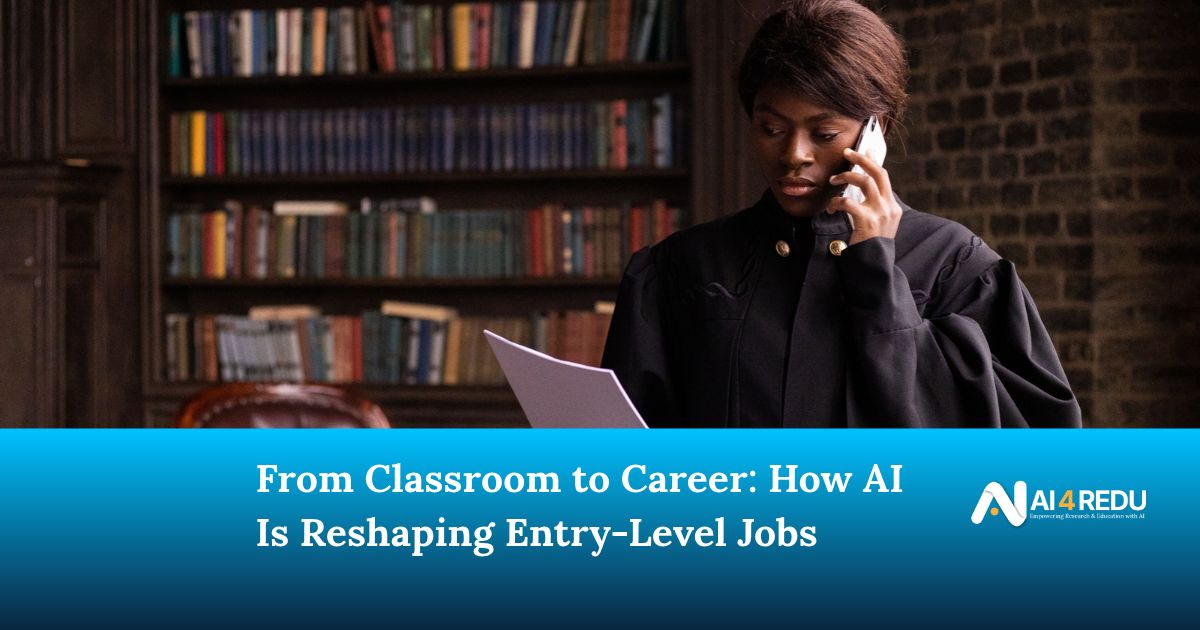
In law, generative AI can assist with document review, legal research, contract analysis, summarization and drafting. A graduate solicitor or paralegal still needs legal judgement, however. AI-generated material must be checked for accuracy, relevance, confidentiality and context.
Finance presents a similar pattern. AI can help process financial information, identify patterns, produce summaries and automate parts of reporting. But interpreting what those numbers mean for a business, communicating recommendations to a client and understanding risk still require human judgement.
This distinction matters because AI exposure does not automatically mean job replacement. The ILO’s 2025 research finds that clerical occupations remain the most exposed to generative AI, while some highly digitized professional and technical occupations are also seeing increased exposure as AI capabilities expand. Yet the organization concludes that transformation is generally more likely than full automation.
For graduates, this creates a new expectation: do not compete with AI on tasks AI performs well. Learn to use AI to perform those tasks better, then focus your contribution on what comes next.
A graduate who can use AI to produce a first-pass analysis and then identify its weaknesses may be more valuable than one who spends twice as long producing the same analysis manually.
Why Employers Still Need Graduates (Just Differently)
If AI can complete routine work, why hire graduates at all?
Because organizations do not simply need people who can produce documents or information. They need people who can understand problems, work with colleagues, make decisions, communicate with customers and adapt when circumstances change.
The World Economic Forum’s 2025 research highlights this combination. AI and big data are among the fastest-growing skills, but employers also expect creative thinking, resilience, flexibility, agility, analytical thinking and curiosity to remain increasingly important.
This is good news for students from a wide range of academic backgrounds.
You do not necessarily need to become an AI engineer. You do need to understand how AI affects the work you want to do.
The Rise of “AI-Fluent Generalist” Roles
One of the most useful ways to think about the future graduate employee is as an AI-fluent generalist.
An AI-fluent generalist understands a business problem, knows which tools can help solve it and can move between technology and human collaboration.
For example, imagine a marketing graduate asked to investigate why a campaign underperformed. Instead of manually sorting every piece of customer feedback, the graduate could use AI to categorize comments and identify recurring themes. They could then validate those findings against the underlying data, identify limitations in the analysis and turn the evidence into a recommendation for the marketing team.
The value is not simply “knowing how to use ChatGPT.”
It is knowing when to use AI, how to instruct it, how to evaluate its output and how to turn that output into a useful business decision.
The same principle applies across industries. A human resources graduate might use AI to analyze employee survey themes. A finance graduate might automate elements of spreadsheet analysis. A communications student might use AI to create alternative drafts before applying their own editorial judgement.
This combination of technical literacy and human capability is increasingly important. The OECD has also found that AI-related skills are spreading beyond narrowly technical occupations, while communication, problem-solving, creativity and teamwork have become important complementary capabilities.
For students, this means your degree subject still matters but it is only part of your employability profile.
New Entry Points Created by AI
AI is not only removing tasks. It is also creating new work.
As organizations introduce AI systems, someone needs to test them, monitor their performance, manage data, assess risks, improve workflows and make sure humans remain involved when automated decisions are inappropriate.
Some of these roles are highly technical. Others are accessible to graduates with strong communication, analytical or domain knowledge.
Prompt Engineering, AI Quality Assurance, and Human-in-the-Loop Roles
Prompt engineering became one of the most visible new AI-related career concepts after the arrival of generative AI. Dedicated prompt-engineering positions exist, although students should be cautious about treating the title as a guaranteed career path. Prompting is increasingly becoming a general workplace skill rather than something performed only by specialists.
The more durable skill is understanding how to structure instructions, provide context, define constraints and evaluate AI responses.
AI quality assurance (AI QA) is another emerging area. AI systems can produce inaccurate, inconsistent or biased outputs. Organizations therefore need people who can test systems systematically, identify failure patterns and establish processes for checking results.
This can suit graduates with backgrounds in technology, data, research, communications or domain-specific subjects.
Then there are human-in-the-loop roles, where people remain responsible for reviewing or validating AI-generated work. A human reviewer might check an AI-generated document, verify information, assess a recommendation or decide whether an automated action should proceed.
These roles illustrate an important point about the future of work: AI adoption can create demand for people who understand both the technology and the context in which it is being used.
The wider labor market supports this shift. The World Economic Forum identifies AI and machine learning specialists, big data specialists and fintech engineers among the fastest-growing occupations in percentage terms through 2030. It also reports that AI and information-processing technologies are expected by 86% of surveyed employers to transform their businesses by 2030.
But you should not assume that every graduate needs to become a machine-learning specialist.
For most students, a stronger strategy is AI plus your existing discipline.
AI + law.
AI + finance.
AI + marketing.
AI + healthcare.
AI + education.
AI + engineering.
AI + policy.
The combination can be more distinctive than either skill alone.
How to Talk About AI Skills in Interviews and CVs
One of the biggest mistakes graduates can make is listing “AI” as a vague skill.
Writing “proficient in AI” on a CV tells an employer very little.
Instead, demonstrate what you can actually do.
For example, compare:
Weak:
“Experienced with generative AI.”
Stronger:
“Used generative AI to accelerate research and produce first-draft summaries, then fact-checked outputs against primary sources.”
The second statement communicates a process: use AI, evaluate it and take responsibility for the result.
You can use the same approach when discussing AI in interviews.
1. Explain the problem you solved
Do not start with the AI tool. Start with the task.
“I needed to analyze 200 pieces of customer feedback…”
2. Explain how you used AI
Then describe the workflow.
“I used an AI tool to categorize recurring themes and produce an initial summary…”
3. Show your judgement
This is the part many candidates overlook.
“I manually reviewed a sample of the classifications and found several categories the model had misunderstood…”
4. Describe the outcome
Finally, explain what changed.
“After refining the categories, I produced a more reliable analysis that helped identify three recurring customer concerns.”
This demonstrates far more than familiarity with a chatbot. It demonstrates analytical thinking, critical evaluation and responsible technology use.
The same principle applies to your CV. Where possible, include AI skills alongside evidence of results.
Instead of listing:
- Generative AI
- Prompt engineering
- ChatGPT
consider describing capabilities such as:
- AI-assisted research and synthesis
- AI workflow design and automation
- Output evaluation and fact-checking
- Data analysis and interpretation
- Responsible use of generative AI
- Human review of AI-generated content
These descriptions are more transferable because tools will change.
The World Economic Forum expects technological skills including AI and big data, networks and cybersecurity, and technological literacy to grow rapidly in importance through 2030. But it also identifies analytical thinking as the leading core skill and highlights resilience, flexibility, creative thinking and lifelong learning.
That combination provides a useful formula for graduates:
AI literacy + subject expertise + human judgement + communication.
Build an AI portfolio before you graduate
You do not have to wait for your first job to demonstrate these abilities. Create small projects that show how you use AI responsibly in your field.
A business student could analyze a public dataset and document where AI helped and where human verification was necessary.
A law student could compare AI-generated legal summaries with authoritative sources and discuss the limitations.
A computer science student could build an AI-enabled application and document testing and failure cases.
A communications student could demonstrate an AI-assisted content workflow while explaining how they maintained accuracy, tone and originality.
The important thing is not to create an impressive-looking collection of AI outputs. It is to show your thinking around the outputs.
The Graduate Advantage Is Changing
The first rung of the career ladder is being redesigned.
AI is likely to absorb more repetitive, predictable and information-processing tasks. That could make some traditional graduate roles smaller or change the number of people employers need for particular functions. The World Economic Forum expects significant disruption across the labor market by 2030, including growth in technology-intensive occupations alongside declines in several clerical and administrative roles.
But disruption is not the same as the end of opportunity.
The emerging advantage belongs to graduates who can combine domain knowledge with technological fluency and distinctly human capabilities.
Your degree gives you a foundation. AI gives you another layer of capability. Critical thinking tells you when the technology is wrong. Communication helps you explain the result. Curiosity helps you keep learning as the tools evolve.
For students entering the job market now, the goal should therefore not be to become “AI-proof.”
There may be no such thing as an AI-proof career.
Instead, aim to become AI-capable: someone who understands the technology, uses it productively, questions its limitations and brings knowledge and judgement that cannot simply be reduced to an automated output.
Conclusion
The classroom-to-career transition is changing, but it is not disappearing.
The graduates who adapt fastest may be the ones who stop asking whether AI will replace entry-level work and start asking a more useful question:
What can I do with AI that I could not do before and what uniquely human value can I add to the result?