
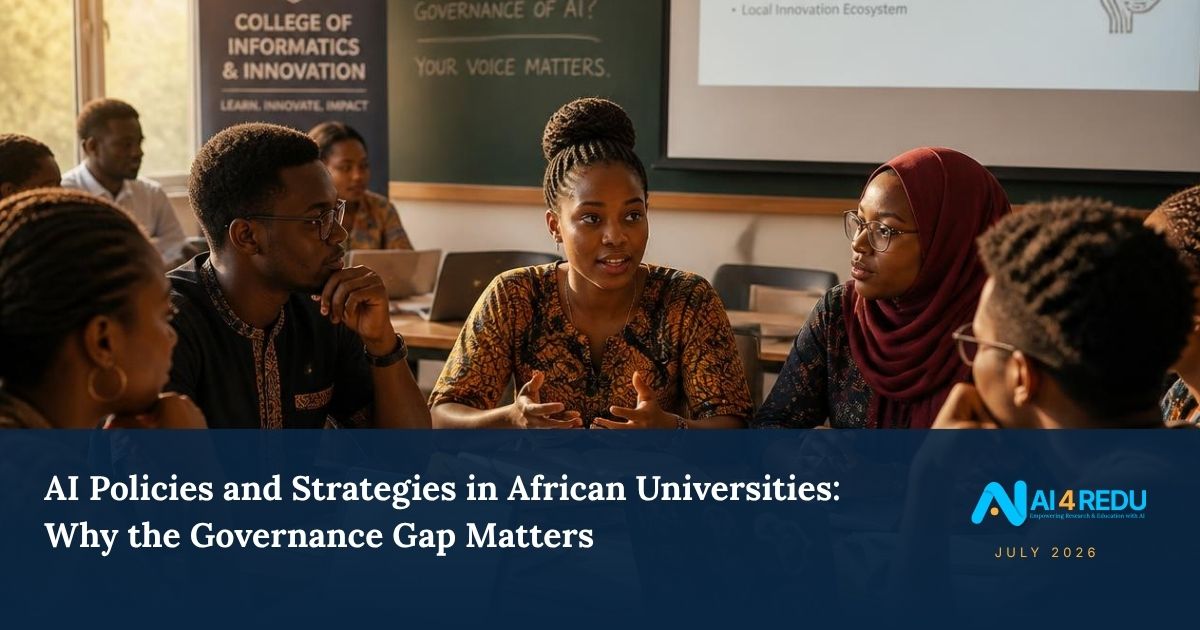
AI Policies and Strategies in African Universities: Why The Governance Gap Matters
Introduction
Generative AI tools like ChatGPT, Microsoft Copilot, and Google Gemini have moved from novelty to daily habit on African campuses. Students use them to draft essays, summarize readings, and brainstorm ideas. Lecturers use them to build course materials and mark faster. Yet behind this rapid adoption sits an uncomfortable truth: most African universities still don’t have a formal AI policy telling anyone what “acceptable use” actually looks like.
This article breaks down where African higher education stands on AI governance today, which universities are leading the way, why so many institutions are still stuck, and what needs to happen next.
Why AI Policy Matters for African Higher Education
AI is reshaping how teaching, learning, research, and institutional governance happen across the continent. The upside is real: faster research, wider access to knowledge, and new tools for academic productivity. The downside is just as real — academic integrity risks, unclear data privacy practices, and murky intellectual property questions that most institutions haven’t addressed in writing.
A handful of universities have started building formal AI governance frameworks, revising how they assess student work, and investing in AI research. Institutions such as the University of Cape Town, the University of the Witwatersrand, North-West University, Strathmore University, and Carnegie Mellon University Africa are leading that shift. Continental bodies are pushing in the same direction: the African Union Continental Artificial Intelligence Strategy and UNESCO’s Recommendation on the Ethics of Artificial Intelligence both call for responsible, transparent, human-centered AI adoption in education.
But policy adoption remains patchy. Compared with universities in Asia, Europe, and North America, AI governance in African higher education is still in its early stages, and most student AI use isn’t guided by any institutional policy at all.
What Continental Bodies Recommend
The African Union’s Continental AI Strategy
The African Union frames AI as a transformative force reshaping healthcare, education, finance, and agriculture across the continent. Its Continental Artificial Intelligence Strategy calls on governments and universities to promote responsible AI use, invest in AI research, and set ethical guidelines for how individuals and institutions use these tools — positioning Africa as an active participant in the global AI economy rather than a bystander.
UNESCO’s Recommendation on the Ethics of AI
UNESCO has shaped much of the AI policy conversation across Africa through its Recommendation on the Ethics of Artificial Intelligence. The guidance is direct: universities implementing AI should prioritize transparency, inclusiveness, fairness, human oversight, and privacy protection.
The AI Policy Vacuum in African Universities
The gap between AI adoption and AI governance is widening fast. Research titled “The Need For AI Policies In African Universities” found a 270% increase in AI-generated research output across African universities in a single year, with 74% of African students actively using AI chatbots for academic work. Despite this, students consistently report minimal institutional guidance on how — or whether — they should be using these tools.
Outside a small group of South African universities, most institutions across the continent lack detailed AI guidelines even though student AI usage is already high. The University of Cape Town, Johannesburg University, and the University of Pretoria have had AI usage guidelines in place since 2024. Kenya tells a different story: no Kenyan public university currently has an official AI policy. Compare that to the United States, where roughly 70% of universities have adopted written AI usage guidelines for students, and the scale of the gap becomes clear.
What Happens When Universities Don’t Have an AI Policy
The disconnect between AI adoption and policy development creates real, compounding risks:
- Inequitable access to AI tools among students, depending on income, device access, or connectivity
- Academic integrity violations, driven by unclear standards for what counts as acceptable AI use
- Missed opportunities for pedagogical innovation that a clear framework could actually enable
- Insufficient preparation for AI-augmented professional practice after graduation
Experts warn that universities without formal AI policies risk falling further behind institutions that already have governance structures in place — not just in reputation, but in graduate readiness for an AI-augmented workforce.
Universities Leading AI Adoption in Africa
University of Cape Town, South Africa
The University of Cape Town (UCT) has built the most advanced AI framework of any African university, taking a governance-focused approach that spans teaching, administration, and research. In 2025, UCT endorsed its AI in Education Framework, embracing responsible use of tools like Gemini, Claude, and ChatGPT rather than banning them, and pushing lecturers to redesign assessments around critical thinking instead of AI-produced answers.
How UCT is implementing AI policy:
- Institution-wide AI in Education Framework guiding teaching and learning
- University-wide guidance in place of blanket bans on generative AI
- Faculty-level review of assessment methods to reduce AI-assisted misconduct
- Assignment redesign focused on critical thinking and authentic work
- Encouraged student disclosure of AI use where relevant
- AI guidance for researchers via the Ethics in Research Committee
- Staff development initiatives to build AI literacy
- A dedicated UCT AI Initiative coordinating research and cross-disciplinary collaboration
- Support for AI research on African challenges — healthcare, climate change, poverty
University of the Witwatersrand, South Africa
Wits has adopted one of the continent’s most comprehensive university-wide AI policies — a formal policy, not temporary guidance, spanning teaching, research, innovation, and administration. The policy is anchored in academic integrity and is explicit that AI should support, not replace, human learning and scholarship.
What sets Wits apart is its six institutional AI principles, paired with faculty-specific guidance for Health Sciences, Engineering, Humanities, Commerce, and Science — recognizing that acceptable AI use in medical education looks nothing like acceptable AI use in a humanities essay.
How Wits is implementing AI policy:
- Formal university-wide Artificial Intelligence Policy
- Six institutional AI principles guiding ethical use
- Faculty-specific AI guidance reflecting disciplinary differences
- Departmental flexibility to adapt AI use to course learning outcomes
- AI guidance embedded across teaching, research, assessment, and administration
- Academic integrity guidelines built specifically for generative AI
- A “responsible use” stance rather than prohibition
- Dedicated guidance for students, lecturers, researchers, and staff
- Regular updates as AI technology evolves
North-West University, South Africa
North-West University (NWU) has positioned itself as a national leader in AI governance with a human-centered, ethical framework covering teaching, research, assessment, and management. NWU also runs an online AI policy portal giving staff and students access to the university’s AI framework, governance policies, academic integrity guidance, UNESCO’s AI competency frameworks, South Africa’s National AI Policy Framework, and the Africa Declaration on Artificial Intelligence — a practical model for linking institutional policy to national and international frameworks.
How NWU is implementing AI policy:
- One of South Africa’s first comprehensive university AI policies
- Human-centered AI governance framework
- AI governance integrated into teaching and research practice
- A dedicated online AI policy portal for staff and students
- Direct access to UNESCO competency frameworks and national policy resources
- Emphasis on ethical use, transparency, and accountability
- Ongoing AI literacy development across the university
- Alignment with South Africa’s National AI Policy Framework
Strathmore University, Kenya
Strathmore University has become one of East Africa’s leading hubs for AI education and digital innovation. While it’s still building institution-wide governance on the scale of South Africa’s leading universities, Strathmore has invested heavily in AI research, innovation ecosystems, entrepreneurship, and industry partnerships — with applications aimed squarely at African priorities like healthcare, financial inclusion, agriculture, and public service delivery.
How Strathmore is implementing AI policy:
- Investment in specialized AI academic programmes
- Expanded AI governance and digital policy research through CIPIT (Centre for Intellectual Property and Information Technology Law)
- Partnerships with technology companies and government agencies
- Support for AI innovation through entrepreneurship hubs
- Applied AI research in healthcare, agriculture, financial inclusion, and public services
- AI integrated into digital skills and innovation training
- Active collaboration between academia, industry, and policymakers
- Capacity building for AI across East Africa
Carnegie Mellon University Africa, Rwanda
Carnegie Mellon University Africa, based in Kigali, has taken a capacity-building approach rather than focusing primarily on institutional regulation. The university trains AI engineers, data scientists, and machine learning specialists who go on to power Africa’s digital economy, working with governments, private companies, and international organizations on AI innovation in healthcare, cybersecurity, smart cities, and digital infrastructure.
How CMU-Africa is implementing AI policy:
- Expanded postgraduate programmes in AI, machine learning, and data science
- AI research aligned with African development priorities
- Government partnerships to build continental AI capacity
- Private-sector collaboration on AI innovation projects
- Interdisciplinary research through international partnerships
- Sustained investment in Africa’s AI talent pipeline
- Applied AI work in cybersecurity, healthcare, digital infrastructure, smart cities
- Support for regional digital transformation through graduate training
Why AI Policy Development in African Universities Is Still Slow
Even with visible progress at institutions like UCT, most African universities are still working through a set of structural barriers that make comprehensive AI governance genuinely difficult to build.
Limited Digital Infrastructure
Unreliable internet, limited computing facilities, weak cloud infrastructure, and restricted access to high-performance computing remain common across the continent. The World Bank points to limited internet access, inadequate computing infrastructure, and digital skills shortages as persistent barriers in low- and middle-income countries — and advanced AI applications need robust infrastructure to run at scale.
Funding Constraints
Building AI research centers, licensing AI software, upgrading digital infrastructure, and training staff all require sustained investment. Most public universities in Africa operate under tight budget constraints, which makes that kind of sustained investment hard to commit to.
Shortage of AI Expertise
There simply aren’t enough lecturers, researchers, and technical specialists with deep AI and AI governance expertise to go around. That skills gap slows curriculum development, policy formulation, and research capacity all at once.
Academic Integrity and Assessment
Generative AI has changed what “doing the work” means. Universities need to decide when AI-assisted work is acceptable, how students should disclose AI use, and how lecturers can design assessments that measure genuine understanding rather than AI output.
Ethical and Legal Concerns
Institutions also have to grapple with algorithmic bias, data privacy, intellectual property, copyright ownership, transparency around AI-generated content, and accountability for AI-assisted decisions. Left unaddressed, these issues erode trust in the technology itself.
Recommendations for Strengthening AI Policy in African Universities
To capture AI’s benefits without absorbing its risks, African universities need governance frameworks that balance innovation with ethical responsibility:
- Develop institution-wide AI policies that give clear guidance to students, lecturers, researchers, and administrators
- Review and update AI policies regularly to keep pace with fast-moving technology
- Invest in AI literacy programmes for staff and students alike
- Establish multidisciplinary AI governance committees spanning education, technology, ethics, law, and data governance
- Strengthen cybersecurity and data protection to safeguard institutional and student information
- Increase investment in AI research centers, digital infrastructure, and computing resources
- Build collaboration among universities, governments, industry, and international organizations to share expertise
- Align institutional policy with continental frameworks like the African Union Continental AI Strategy and UNESCO’s Recommendation on the Ethics of Artificial Intelligence
The Bottom Line
AI adoption in African universities is happening whether institutions have a policy or not — 74% of students are already using AI chatbots for academic work. The real question isn’t whether AI belongs in higher education; it’s whether universities will shape how it’s used before the gaps in equity, integrity, and preparedness widen further. Institutions like UCT, Wits, NWU, Strathmore, and CMU-Africa show it’s possible to build thoughtful, human-centered AI governance without stalling innovation. The rest of the continent’s universities now have a working blueprint to follow.