
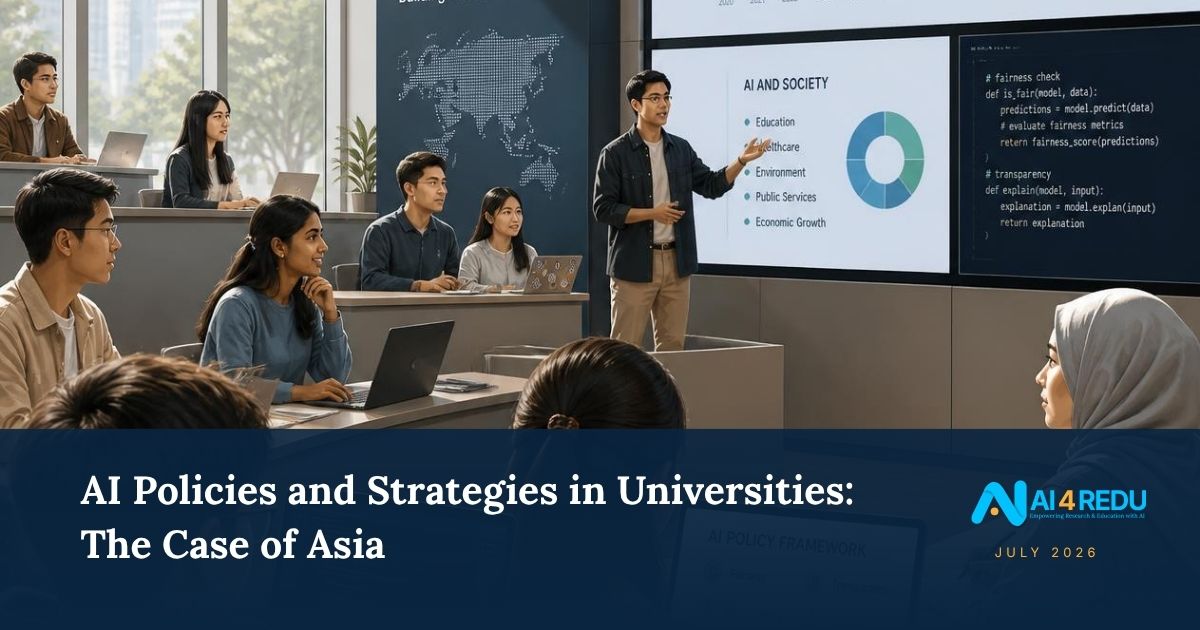
AI Policies and Strategies in Universities: The Case of Asia
How leading Asian institutions are governing generative AI — and what other universities can learn from them.
Introduction
Artificial intelligence (AI) is restructuring higher education across Asia, prompting universities to develop formal governance frameworks that support responsible AI adoption while protecting academic integrity, research quality, and institutional accountability. Rather than banning generative AI tools outright, many leading universities have introduced comprehensive policies that regulate how students, faculty, and researchers use AI in teaching, assessment, and scholarly work.
These policies extend beyond classroom guidelines. They cover institutional governance, ethical AI principles, research oversight, faculty responsibilities, and implementation mechanisms that keep AI use safe and transparent. As the technology keeps evolving, universities are recognizing that effective governance depends not only on well-written policy documents, but on how consistently those policies are put into practice.
As AI adoption grows, universities across Asia are building governance frameworks that support responsible innovation while addressing risks such as academic misconduct, data privacy, and ethical AI use. Their approaches offer valuable insights into how higher education can harness AI without compromising academic excellence.
Statistics on AI Policies and Strategies in Chinese Universities
China has emerged as one of the global leaders in adopting AI within higher education, and recent empirical evidence shows just how deeply generative AI has become embedded in university teaching and learning.
A nationwide survey of 72,615 undergraduate students across 25 Chinese universities found that more than 60% of students used generative AI during the 2023–2024 academic year, with academic applications outpacing personal or recreational use. Students most commonly used AI tools for information retrieval, writing assistance, and problem-solving — though the study noted that how effective this use was depended heavily on course design and instructor support.
A second nationwide study, surveying 12,678 undergraduate students across 20 Chinese universities, confirmed widespread adoption and went a step further by identifying four distinct types of AI users based on adoption patterns and critical-thinking behavior:
- 42% — Cautious users
- 24% — Task substituters
- 21.2% — Balanced explorers
- 12.8% — Advanced users
Together, these findings suggest that while generative AI use is now the norm rather than the exception, Chinese universities continue to encourage responsible and critical engagement with AI rather than unrestricted dependence on it.
Leading Universities That Have Adopted AI Policies in Asia
AI Policies and Strategies at the National University of Singapore (NUS)
NUS has built a comprehensive AI governance framework that promotes the responsible use of generative AI in teaching, learning, and research. Through its Policy for the Use of AI in Teaching and Learning, the university encourages ethical AI integration while emphasizing academic integrity, transparency, and human oversight. Students must comply with course-specific AI guidelines and disclose AI use where required, while instructors remain accountable for the accuracy and fairness of any AI-assisted teaching materials and assessments.
Beyond the classroom, NUS has strengthened its institutional AI strategy through the NUS Artificial Intelligence Institute, which drives research into trustworthy AI, governance, AI safety, and public policy.
Implementation Process
NUS puts its policy into practice through a governance model that pairs institutional oversight with faculty-level responsibility. Instructors set course-specific AI rules and communicate them to students at the start of each course. Where AI is used for tasks like automated feedback or grading, departments run AI risk assessments before rollout to ensure the tools meet institutional standards. The NUS Artificial Intelligence Institute supports this work with ongoing research, governance guidance, and policy development.
[Image suggestion: NUS campus photo — see licensed stock options above, or use your own institutional photography.]
Policies and Strategies at Nanyang Technological University (NTU)
NTU has adopted a governance framework that supports the responsible use of generative AI across teaching, assessment, and research. Instead of restricting AI tools, the university encourages ethical use while safeguarding academic integrity and independent learning. NTU’s guidance places particular emphasis on redesigning assessments to evaluate critical thinking and problem-solving, rather than relying on AI-detection software — whose accuracy the university acknowledges can be unreliable.
Researchers at NTU are required to use AI responsibly: disclosing AI assistance where appropriate, protecting confidential data, and ensuring AI-generated content complies with research ethics and intellectual property rules.
Implementation Process
NTU implements its policy through institution-wide guidance paired with faculty-led application. Instructors decide what counts as acceptable AI use based on course learning outcomes and set expectations at the start of term. The university backs this up with teaching resources and assessment frameworks, while researchers must meet institutional requirements around AI disclosure, data protection, and research ethics. NTU also reviews its guidance regularly to keep pace with new AI capabilities.
AI Policies and Strategies at the Chinese University of Hong Kong (CUHK)
CUHK takes a university-wide approach to governing generative AI, centered on responsible use, academic integrity, and transparency. The university permits tools like ChatGPT to support learning and research, but requires students and staff to follow faculty-specific guidelines and acknowledge AI use where appropriate. CUHK is explicit that AI-generated content can contain inaccuracies or bias — making human judgment essential in academic work.
Faculty members decide what’s acceptable within their own courses, while ensuring assessments still measure students’ own understanding and critical thinking.
Implementation Process
CUHK uses a decentralized model: individual faculties and departments adapt university-level guidance to their own teaching and assessment needs. Instructors set AI expectations per course, and students are expected to follow faculty-specific rules and disclose AI use where required. The university supplements this with guidance materials, awareness campaigns, and periodic policy updates.
AI Policies and Strategies at Tsinghua University
Tsinghua has built one of Asia’s most comprehensive institutional AI governance frameworks through its Guiding Principles for the Application of Artificial Intelligence in Education. The university takes a “proactive yet prudent” approach — treating AI as a valuable educational tool while insisting it should support, not replace, human learning and academic work.
The framework rests on five core principles:
- Principal responsibility
- Compliance and integrity
- Data security
- Prudence and critical thinking
- Fairness and inclusiveness
It requires disclosure of AI use, explicitly prohibits AI-assisted plagiarism and ghostwriting, and forbids feeding sensitive or unauthorized data into AI systems. Students are encouraged to use AI to enhance their learning, but they remain responsible for the originality and accuracy of their own work.
Implementation Process
Tsinghua embeds its guiding principles directly into teaching, coursework, and graduate supervision. Faculty decide what’s acceptable in their own courses and explain expectations at the start of each semester, remaining accountable for any AI-assisted materials they use. Graduate supervisors oversee AI use in theses and research to protect originality and integrity. The university reinforces all of this with AI literacy initiatives, faculty workshops, and continuous policy review.
[Image suggestion: Tsinghua University campus photo — see licensed stock options above, or use your own institutional photography.]
Challenges of Implementing AI Policies and Strategies in Asian Universities
Rapid Evolution of AI Technologies
Keeping AI policy current is one of the toughest challenges Asian universities face. New tools and capabilities emerge constantly, making it hard for institutions to build governance frameworks that stay relevant. Universities must continually revise their policies to address new ethical concerns, technological advances, and shifting teaching and research practices — and research suggests many are still refining their frameworks to keep up.
Balancing Innovation with Academic Integrity
Universities must encourage AI-driven innovation without undermining academic integrity. Generative AI can genuinely enhance learning and research, but it also raises the risk of plagiarism, ghostwriting, and overreliance on AI-generated content. That’s why many institutions are redesigning assessments around critical thinking, creativity, and problem-solving instead of leaning on AI-detection software, whose accuracy remains inconsistent.
Faculty Readiness and AI Literacy
Effective policy implementation depends on faculty having the knowledge and confidence to integrate AI responsibly. But AI literacy varies widely among instructors, which can lead to inconsistent application of the same institutional policy. Universities face an ongoing need to provide continuous professional development, practical guidance, and training.
Data Privacy and Ethical Governance
Protecting sensitive institutional, student, and research data is a major challenge as AI tools become more embedded in higher education. Universities must ensure AI tools comply with institutional data governance policies and national privacy regulations, while also addressing algorithmic bias, intellectual property, and the responsible handling of confidential information.
Consistent Policy Implementation Across Institutions
Many Asian universities let individual departments or instructors decide how AI may be used in their own courses. This flexibility supports discipline-specific teaching, but it can also create inconsistencies in student expectations, assessment practices, and enforcement. Balancing institution-wide governance with disciplinary flexibility remains an ongoing priority.
Recommendations for Strengthening AI Policies and Strategies in Asian Universities
Regularly Review and Update AI Policies
Given how fast AI technology moves, universities should build in mechanisms for regularly reviewing and updating their policies. Periodic evaluations help institutions catch emerging risks, incorporate new AI developments, and keep governance relevant to evolving teaching, research, and administrative practices.
Strengthen AI Literacy for Faculty and Students
Continuous AI literacy programs — workshops, online training, and practical guidance — help faculty and students use AI responsibly and effectively, while improving understanding of academic integrity, prompt engineering, and the limitations of generative AI tools.
Develop Consistent Institution-Wide AI Governance
Departments need flexibility for discipline-specific needs, but universities should still establish institution-wide governance frameworks that set consistent standards for AI use across teaching, research, and assessment.
Prioritize Ethical AI and Data Protection
Universities should strengthen safeguards for data privacy, intellectual property, and research integrity, ensuring AI systems comply with institutional policy and national regulation. Transparency, accountability, fairness, and human oversight should be embedded into every AI governance framework.
Encourage Collaboration and Knowledge Sharing
Asian universities can accelerate progress by collaborating with governments, industry partners, and other institutions to share best practices, research findings, and governance models — supporting responsible innovation across the whole higher education sector.
Final Thought
Asian universities are taking significant steps to build AI governance frameworks that promote responsible innovation while safeguarding academic integrity, research quality, and ethical standards. The case studies of the National University of Singapore, Nanyang Technological University, the Chinese University of Hong Kong, and Tsinghua University show that effective AI governance goes well beyond writing a policy document — it requires structured implementation through faculty guidance, institutional oversight, and continuous review.
Despite challenges like the rapid evolution of AI technologies, uneven AI literacy, and the need for consistent implementation, these institutions keep refining their approaches to ensure AI enhances rather than compromises higher education. By regularly updating policies, strengthening AI literacy, promoting ethical AI practices, and fostering collaboration, Asian universities are well positioned to build sustainable governance frameworks that support innovation while maintaining academic excellence — offering valuable lessons for higher education institutions worldwide.
Sources
- China National Knowledge Infrastructure (CNKI) survey data
- PMC — National Center for Biotechnology Information
- NUS Artificial Intelligence Institute
- NUS Policy for Use of AI in Teaching and Learning
- NTU Teaching, Learning & Assessment with GenAI
- CUHK — Generative AI in Education
- CUHK Academic Honesty Policy
- UNESCO, Guidance for Generative AI in Education and Research
Related posts
AI Policies and Strategies in African Universities: Why The Governance Gap Matters