
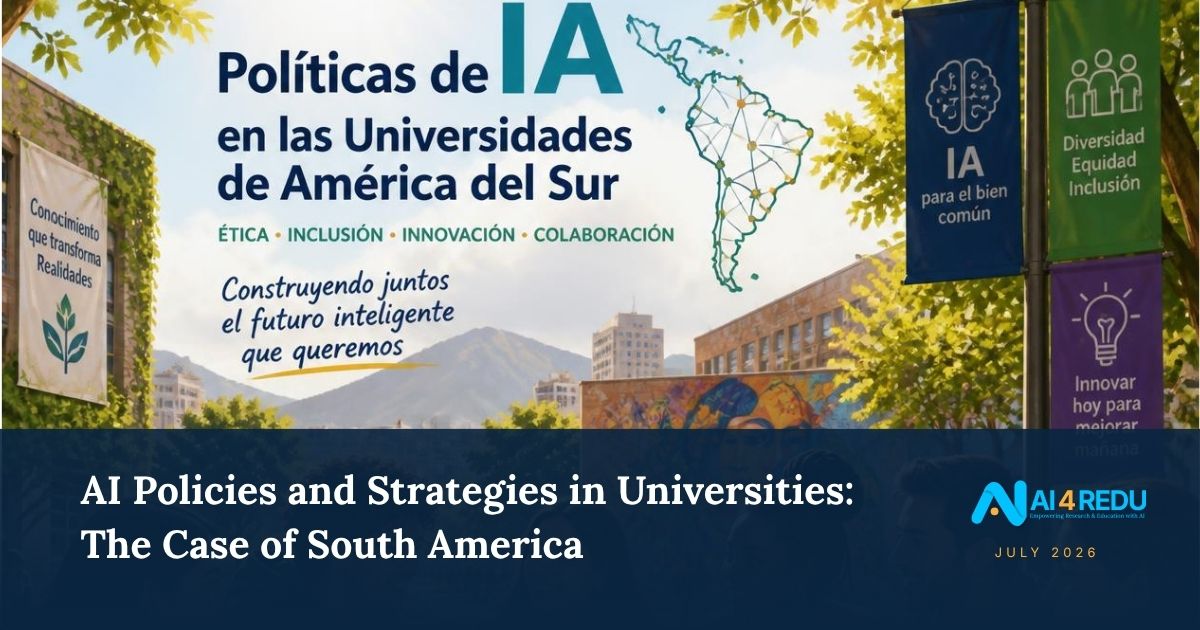
AI Policies and Strategies in Universities: The Case of South America
Introduction: Why South American Universities Are Rethinking AI Governance
Generative artificial intelligence (AI) has prompted universities to rethink how teaching, learning, research, and assessment are conducted. South American higher education institutions have increasingly responded by developing institution-specific AI policies and guidance that encourage innovation while safeguarding academic integrity, research ethics, and educational quality. Rather than imposing blanket prohibitions on AI tools such as ChatGPT, Gemini, and Microsoft Copilot, leading universities across the region have generally adopted governance frameworks that emphasize responsible, transparent, and ethical use.
These institutional policies recognize that generative AI has become a permanent feature of higher education. Consequently, universities are shifting from asking whether AI should be used to determining how it can be integrated responsibly into academic activities. Their strategies typically combine ethical principles, clear expectations for students and faculty, guidance on appropriate and inappropriate uses of AI, and ongoing AI literacy initiatives that prepare university communities to engage with rapidly evolving technologies.
Examining AI policies and implementation strategies at leading South American universities provides valuable insights into how higher education institutions are responding to the opportunities and challenges of generative AI.
The case studies in this article highlight practical approaches to AI governance, ethical use, faculty oversight, student accountability, and institutional capacity building that are shaping the future of higher education across the region.
Statistics on AI Policy Adoption in South American Universities
Recent evidence suggests that generative AI has become deeply embedded in higher education across Latin America, including South America. According to the Digital Education Council’s AI in Higher Education LATAM Survey 2026, which collected responses from more than 30,000 participants across 29 higher education institutions, 92% of university students reported actively using AI tools for learning, while 79% of faculty members also indicated regular AI use. Additionally, 94% of faculty expect to integrate AI into their future teaching practices, highlighting the rapid institutional acceptance of AI technologies.
The survey also found that 61% of students expressed concerns about peers misusing AI for academic work, underscoring why universities across the region are strengthening policies on academic integrity, transparency, and responsible AI use. These findings illustrate that AI is no longer an emerging technology in South American universities but has become a mainstream component of teaching and learning, driving institutions to develop comprehensive governance frameworks that balance innovation with ethical and academic standards.
Case Study 1: Universidade de São Paulo (USP), Brazil
AI Policy Development at USP
As Latin America’s largest public university and one of the continent’s leading research institutions, Universidade de São Paulo (USP) has taken a proactive approach to artificial intelligence by embedding AI governance within its broader commitment to academic excellence and responsible research. Rather than treating generative AI as a temporary technological trend, the university has positioned it as a transformative tool that requires thoughtful institutional oversight.
USP’s approach centers on balancing innovation with accountability. Its institutional guidance recognizes that AI technologies can improve productivity, support teaching, enhance research, and streamline administrative work, while also presenting risks related to misinformation, intellectual property, data privacy, and academic misconduct. Accordingly, the university encourages members of its academic community to use AI responsibly, ensuring that its application aligns with scientific integrity, ethical standards, and the protection of confidential information.
A defining feature of USP’s governance model is its emphasis on human responsibility. AI-generated outputs are viewed as decision-support tools rather than replacements for academic judgment. Faculty members, researchers, and students remain fully accountable for verifying the accuracy, originality, and reliability of AI-generated content before incorporating it into teaching materials, research publications, or academic assignments. This reinforces the university’s position that responsibility for scholarly work always rests with the individual rather than the AI system itself.
Another notable aspect of USP’s policy development is its recognition that AI governance must remain adaptable. Instead of creating rigid rules that could quickly become obsolete as technology evolves, the university favors principle-based guidance that can accommodate future AI developments while maintaining high standards of academic integrity and ethical research.
USP’s AI Implementation Strategy
USP has implemented its AI strategy by integrating responsible AI practices across teaching, research, and institutional administration rather than limiting governance to a single policy document.
Within teaching and learning, instructors are encouraged to determine how AI tools may be incorporated into their courses according to specific learning objectives. This decentralized model allows individual faculties and departments to establish appropriate expectations while remaining aligned with the university’s overarching ethical principles. Students are expected to comply with course-specific AI policies and remain responsible for the originality, accuracy, and integrity of all submitted work.
Research governance is another major pillar of implementation. USP encourages researchers to use generative AI to improve efficiency in tasks such as drafting, summarizing literature, and organizing information. However, researchers are expected to independently verify AI-generated references, factual claims, and analyses before publication. The university also cautions against entering confidential research data or sensitive information into publicly available AI platforms because of potential privacy and data security risks.
Beyond teaching and research, USP promotes responsible AI adoption through institutional awareness initiatives that emphasize intellectual property protection, scientific integrity, ethical decision-making, and responsible innovation. Rather than discouraging experimentation with AI, the university seeks to cultivate a culture in which faculty and students can explore new technologies while understanding their limitations and associated risks.
Case Study 2: Pontificia Universidad Católica de Chile (UC Chile)
AI Policy Development at UC Chile
Pontificia Universidad Católica de Chile has emerged as one of South America’s leading universities in developing comprehensive guidance for the responsible use of generative AI in higher education. Instead of relying solely on academic integrity policies, the university has created a dedicated institutional initiative known as Docencia con IA (Teaching with AI), which provides faculty members with practical guidance, ethical principles, teaching resources, and implementation strategies for integrating AI into university education.
The university’s framework recognizes AI as a tool capable of enriching teaching and learning while emphasizing that human dignity, critical thinking, and meaningful student learning must remain at the center of educational practice. Its guidance encourages instructors to use AI to enhance—not replace—pedagogical decision-making and intellectual engagement.
UC Chile’s policy development is built around several core principles. These include promoting critical thinking when interacting with AI-generated content, encouraging open dialogue between faculty and students about appropriate AI use, ensuring equitable access to AI technologies, protecting data privacy, and maintaining academic integrity. The university also highlights the importance of transparency by recommending that instructors clearly communicate course-specific expectations regarding AI use and publish these guidelines through the institution’s learning management system.
Rather than prescribing a single university-wide rule for every assignment, UC Chile empowers instructors to determine how AI should be incorporated within their courses, recognizing that acceptable AI use varies considerably across academic disciplines. This flexible governance model allows faculty members to adapt AI policies according to learning outcomes while remaining consistent with the university’s ethical framework.
Case Study 3: Universidad de los Andes, Colombia
AI Policy Development at Uniandes
Universidad de los Andes has established one of the most comprehensive institutional frameworks for generative AI governance in Colombia through its Guidelines for the Use of Generative Artificial Intelligence (IAG). Officially launched in October 2024, the guidelines provide a university-wide framework for students, faculty, researchers, and administrative staff, making Uniandes one of the first Colombian universities to adopt a comprehensive institutional AI policy.
The policy was developed through a collaborative and multidisciplinary process involving the university’s Center for Innovation in Technology and Education (CONECTA-TE), the Directorate for Innovation and Academic Development (DIDACTA), the Educational Laboratory (LED), the Office of Digital Transformation, faculty members, students, and senior university leadership. The final document was reviewed and approved by the Academic Council, reflecting broad institutional consensus rather than a top-down administrative directive.
Instead of imposing rigid rules, the university designed the guidelines as a living document that can evolve alongside advances in AI technology. The framework seeks to clarify concepts, establish principles for responsible AI use, and provide differentiated guidance for various university stakeholders. It aligns AI governance with the university’s educational mission by emphasizing critical thinking, ethical judgment, responsible citizenship, and academic integrity.
Another distinguishing feature is its user-centered approach. Rather than producing generic recommendations, the guidelines contain separate recommendations for students, instructors, researchers, and administrative personnel, acknowledging that AI presents different opportunities and responsibilities across institutional roles.
Uniandes’ AI Implementation Strategy
Uniandes has complemented its institutional guidelines with a broader educational strategy that integrates AI into teaching through four interconnected pillars: orientation and reflection, training and capacity building, experimentation, and technological support. This approach recognizes that successful AI governance requires continuous education rather than policy documents alone.
For students, the university identifies several appropriate uses of generative AI, including brainstorming ideas, improving grammar and writing, translating text, generating study guides, supporting coding tasks, and organizing research. However, these activities are only acceptable when instructors authorize AI use and when students remain responsible for the final work they submit. Students are expected to verify AI-generated information, properly acknowledge AI assistance where required, and avoid presenting AI-generated content as their own original work.
Faculty members are encouraged to redesign assessments so that AI complements rather than replaces learning. Instead of prohibiting AI outright, instructors are given the authority to determine acceptable AI use within their courses and are encouraged to communicate those expectations clearly in course materials. This decentralized approach allows AI governance to reflect disciplinary differences while remaining consistent with university-wide ethical principles.
To support implementation, Uniandes also provides professional development opportunities, including workshops and the “Fundamentos del uso de IA generativa” MOOC developed by the Faculty of Engineering. These initiatives help faculty understand prompting techniques, practical classroom applications, ethical considerations, and responsible AI integration. By combining policy guidance with ongoing training, the university seeks to build long-term AI literacy across its academic community.
Key Lessons from South American Universities on AI Governance
The experiences of USP, Pontificia Universidad Católica de Chile, and Universidad de los Andes demonstrate that South American universities are increasingly adopting principle-based AI governance rather than relying on blanket restrictions. Their policies acknowledge that generative AI has become an enduring component of higher education and therefore requires responsible management instead of outright prohibition.
A common feature across all three institutions is the emphasis on human accountability. While AI can assist with drafting, brainstorming, research support, and administrative efficiency, responsibility for academic work always remains with students, faculty, and researchers. Universities consistently stress that AI-generated content must be critically evaluated, verified for accuracy, and used transparently.
Another important lesson is the growing importance of AI literacy. Rather than limiting governance to policy documents, these universities have invested in faculty development programs, institutional guidance, and educational resources that enable their communities to use AI effectively and ethically. This reflects a broader recognition that responsible AI governance depends as much on education as on regulation.
Finally, the case studies illustrate that AI governance is becoming an ongoing institutional process rather than a one-time policy response. By adopting flexible frameworks capable of evolving alongside technological developments, these universities position themselves to respond effectively to future advances in generative AI while maintaining academic integrity and educational quality.
Conclusion: The Future of AI Governance in South American Higher Education
South American universities are moving beyond viewing generative AI solely as a challenge to academic integrity and are instead treating it as a transformative technology that requires thoughtful institutional governance. The experiences of USP, Pontificia Universidad Católica de Chile, and Universidad de los Andes demonstrate that successful AI strategies combine ethical principles, transparent guidance, faculty autonomy, and continuous AI literacy initiatives rather than restrictive policies alone.
Although each institution has developed its own governance framework, all three emphasize responsible innovation, human oversight, and accountability. Their approaches recognize that AI can strengthen teaching, research, and learning when integrated thoughtfully and supported by clear institutional expectations. As generative AI technologies continue to evolve, flexible governance models such as those adopted by these universities are likely to play an increasingly important role in helping higher education balance innovation with academic excellence.
Related posts
AI Policies and Strategies in African Universities: Why The Governance Gap Matters
AI Policies and Strategies in Universities: The Case of Asia